Mercurial barometers were invented in the 1640s, but those made earlier than about 1740 are rare indeed. Most of the ones we sell date from the late-18th to the mid 19th century: they are old enough to be desirable antiques but not so old as to be quite rare and costly.Our barometers are all in working order and in superb condition. Any restoration that has been done has been performed correctly, and the cornices, hands, verniers, thermometers and mercury systems are exactly as they should be for the age and type of barometer. We are happy to deliver the barometers if time and distance allow. Barometers come and go. If you are looking for a specific type, call or e-mail us and we'll put you on our list.We offer a comprehensive restoration service for antique mercury barometers. Please click here for more information. |
|
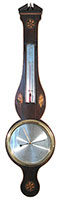
This is a fine mahogany bowfront barometer of the "flat-to-the-wall" form, so called because the , eliminating the need to add spacers to the rear side, and thereby presenting a cleaner line to the eye. It is very finely made, with a fine mahogany flame to the front of the case and solid ebony trim and inlays throughout. The mercury thermometer is graduated in the Fahrenheit and Reaumur scales. There is a minor repair to the mouldings around the cistern area. The barometer is signed Worthington & Allan, Late Berge, London; they practiced at 196 Piccadilly from about 1821 to 1846. It would appear that Worthington & Allan took over the business of the eminent Matthew Berge (successor to Jesse Ramsden), at 199 Piccadilly, who died in 1819. Possibly they were part of Berge's staff, as the barometer is extremely well made, fully the quality of Berge's output. 38.5 Inches high |
|
Francis Amadio, Sr.,
Optical, Mathematical and Philosophical Instrument Maker,
began his practice at the address on this instrument, 118
St. John St. Road, about 1800. He was joined by his son,
Francis Jr., within a very few years and the firm then generally
used the name F. Amadio & Son until at least 1844.
The Amadio name carried on until at least 1865. The
Amadio workshops were respected for the high quality of their
instruments as demonstrated by the fine inlay and engraving
on this dial barometer. It features a good low scroll cornice, adjustable
hygrometer, removable Fahrenheit thermometer,
and a profusely
engraved main dial. The case, veneered in mahogany,
is outlined by a triple line of boxwood and ebony stringing
and accented
by lily-of-the-valley inlays. There is some restoration
to the cornice and minor repairs to the stringing.
Circa 1810 |
George III period dial barometer by L Donegan & Co., London. This early dial barometer
is beautifully made, with the short
shoulders below the cornice and the wide, graceful curve
of the case next to the thermometer box that mark it as Georgian. The
four inlays are of the fan style rather than the later shell
and flowers form, and the case is outlined with checkered
stringing of boxwood and ebony. Sides are crossbanded. The thermometer
plate is graduated in the Fahrenheit scale and decorated
with foliage engraving at the top. The weather
dial is finely engraved with a large compass star in
the center. There is some minor restoration to the
stringing and the finish has been repolished. Circa 1810 |
|
Mid-19th
Century rope-twist carved mahogany Carved
English marine barometers first began to appear around the late
1830s. Edwin Banfield, in his book on stick barometers, notes
that they were made not only for use on ships, but for display
in homes as well, presumably for patrons associated with the
shipping business or ship building, or for private yachts and
flagships in the British Navy. Of those barometers, the most
desirable form is the mahogany case carved to resemble a length
of cable, or the "rope-twist" motif. These were expensive
instruments when they were made, with their ivory register plates
and fine brass mounts.
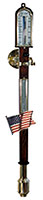
This barometer, made by the firm of Charles W. Dixey in the 1840-1850 period, is a good example. The circular pediment with its deep fluted carving is almost restrained, compared to others of the period. A band of foliate carving sits just atop the brass gimbal, then the rope-twist case terminates in an acanthus carved section and a gadrooned ring just above the brass cistern cover. The ivory register plates carry Dixey's name and address, and the is likewise on an ivory plate. The mercury system uses the three-piece on threaded mounts, and the mercury tube is constricted to prevent surging in rolling seas. Restorations are limited to cleaning and waxing the finish, cleaning the brass of any corrosion, and a replacement gimbal assembly. The Dixey family business originated in the third quarter of the 18th century with Edward Dixey. His son, Charles Wastell Dixey practiced at 3 New Bond Street, London, the address on this instrument, from 1838 to 1862. In 1863, the name of the company changed to C.W. Dixey and Son and continued well into the 20th century. The engraving on this barometer states Opticians to the Queen, indicating a date of post 1837 when Victoria ascended to the Throne. Dixey also produced instruments for many of England's 19th century nobility. Circa 1840-1850 |
Regency Period mahogany stick barometer by Watkins of Bristol This is a very clean and crisp example of the Regency Period glazed-door stick barometer by a leading maker of the time in the city of Bristol. The silvered brass register plate carries the weather indications and the Fahrenheit spirit thermometer. The trunk is veneered in the V-shaped 'herringbone pattern'. Mercury system is a bulb cistern glass tube. Restorations include some minor work to the cornice and a replaced cistern cover. The finish is recently repolished. The instrument is signed Watkins, Clare Street, Bristol. We believe this is William Watkins, practicing at this address prior to his move about 100 yards away to 16, St. Augustine's Parade at about 1830 or so. Watkins is listed by Banfield as Optical and Mathematical Instrument Maker (Optician), working as late as 1840. 38.5" high |
|
This fine 8-inch dial barometer has several design features that date it very close to the turn of the 19th century. The smooth curves of the case and its, the design of the dial's engraving with the weather indications around the outside, the short shoulders at the cornice, and the very flat angle to the cornice mouldings all are signs of early production in a dial barometer. The use of a separate set knob and rack system are not usually found in eight inch dial barometers that date into the later Regency Period. The instrument is signed C. Pitsala @ Co., London, for Charles Pitsalla, working 1800-1820 at 221 High Holborn, London. Barometers signed just "C.Pitsalla" and "C. Pitsalla & Co. are known from the same period. 39.5 Inches high, 10.5 inches
wide |
|
Makers working in England’s
late Georgian Period produced some of the most elegant
barometers of any time. Forms are clean and graceful, and
handsome decorative inlays and stringing were used. This
is one such example made by J M Ronketi. The glazed
door over the silvered
register plate is shaped at the lower edge to
merge smoothly with the slim trunk of the case, and boxwood
and ebony checkered stringing surrounds the door and runs
in a double line down the sides of the trunk. The color
is nicely mellowed to a soft brown. There is an old repair
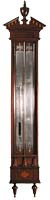
to the cistern cover, which is original. 38.5“ High, 5.25” Wide (cornice) |
|
This early dial barometer has the short shoulders below the cornice, the graceful curve of the case around the thermometer box and the cross banded side veneers typical of Georgian period dial barometers. Unusual fan inlays decorate the case, which is outlined with triple lines of boxwood and ebony stringing. The weather dial is finely engraved, and has horizontal weather indications, a format seldom seen after 1800. The thermometer plate is graduated in the Fahrenheit scale. There is some minor restoration to the cornice and the finish has been repolished. Signed Frans Prola, Liverpool, this barometer was made prior to the Regency Period. Circa 1800-1805
|
|
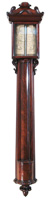
The mahogany case has a moulded pediment, highly figured veneers, and ebony stringing (in memory, it is said, of Lord Nelson). The silvered brass register plate is engraved with the makers' names, and the three weather indications follow the simpler version proposed by George Adams in 1790. An ivory knob operates the rack vernier. A long mercury thermometer is mounted on the case in a detachable box; its engraved plate has dual Fahrenheit and Reaumur scales ranging from 0 to 120 degrees F. The turned cistern cover protects the boxwood cistern whose closing screw is operated by the vernier knob. The partnership of Watkins and Hill was formed in 1819, when Jeremiah Watkins took on a descendant of Nathaniel Hill. They practiced at 5 Charing Cross, London. Circa 1825 |
|
Barometers with dials of less than eight inches in diameter appeared as early as 1815, and by 1830 the form was quite popular. Dials as small as four inches are known and these instruments, which rely on shape and figured veneers rather than decorative inlays, are often quite elegant. This barometer has a six inch dial and very handsome figured mahogany veneers on the front of the case, outlined by one solid line of ebony stringing. The delicate scroll pediment lightens the somewhat geometric lines. The condition is nicely original, with only minor repairs to the cornice mouldngs and a replaced finial. The finish is an older French polish in very good condition. The maker's name is on an applied plaque at the 6:00 position of the dial. It is signed G. D. Angelo & Co. Fecerunt Winchester (also listed as G. D'Angelo) who practiced in Winchester and nearby Basingstoke from 1800 to 1840. Circa 1830-40 |
|
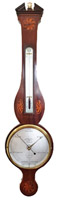
This is one of the first of the “Sheraton Shell” barometers, with the conch shell and flower inlays that were just coming into fashion. It has the late 18th century form of case, with the short shoulders below the cornice, crossbanded sides, checkered stringing, and the wide, graceful curve of the case through the thermometer section. The thermometer plate is graduated in the Fahrenheit scale and decorated with foliage engraving at the top. The weather dial is engraved with the weather indications at the outer perimeter, a convention that changed in the next few years. The finish is old and in very good condition, and there has been some minor restoration to the stringing and the cornice mouldings. Banfield lists Joseph Gafurio as practicing in the city of Chester from 1810 to 1830. Instruments are known signed both Joseph Gafurio, as this one is, and Gafurio and Company. 39" high, 10" wide |
Please contact us if
you're looking for a particular type of barometer
or wish to be notified when we update this catalog.
Or simply Email:
Our Reference Section that
contains photos and descriptions of barometers that have been sold
has been moved HERE . No need to download
photos that don't particularly interest you!
Looking for a barometer? Check our Coming Attractions for instruments now in restoration.
![]()
|
Please,
please, please.... note: |